

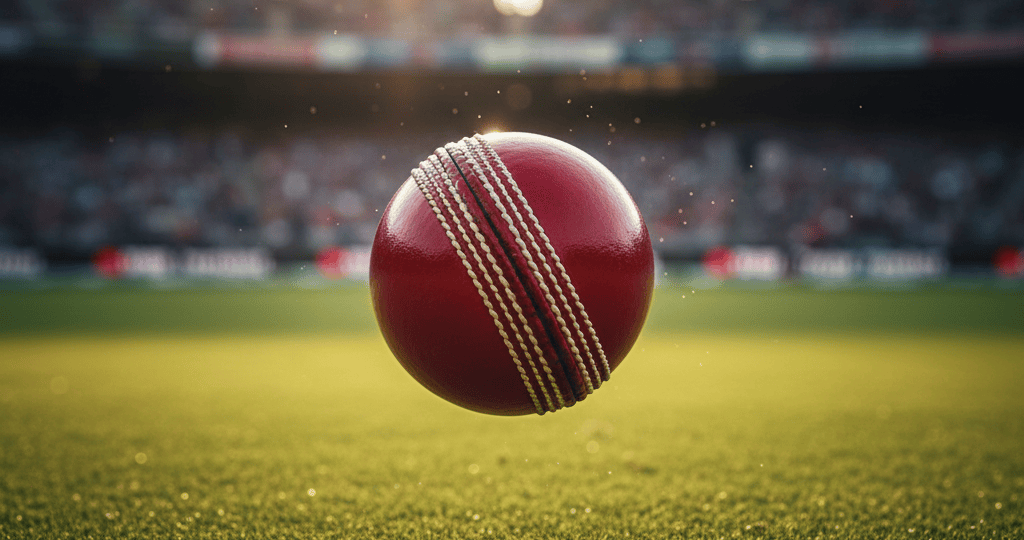
Leather ball. It’s just two words, but say them to any true devotee of the sport, and you immediately evoke a visceral reaction. It might be the memory of the sting in the palms after taking a sharp slip catch on a freezing cold morning, the satisfying, meaty thwack when a batsman times a drive perfectly right out of the middle of the willow, or the terrifying blur of red whistling past a helmet grille at 90 mph. If you ask a casual observer what defines cricket, they might point to the flat bat or the expansive green oval. But a player knows the truth. The soul of cricket isn’t the willow; it’s that dense, menacing, beautiful leather cricket ball that dictates every moment of play.
Why the Leather Cricket Ball is the Soul of the Sport
That 5.5-ounce standard leather cricket ball, a lump of cork, string, and cowhide, is the sun around which the entire cricketing universe orbits. Every tactic devised by a captain, every bead of sweat dropped by a fast bowler, and every gasp from the crowd is dictated by what that sphere of leather is doing at any given moment.
It is an object of obsession, fear, reverence, and, occasionally, deep frustration. To hold a brand-new leather cricket ball is to hold potential energy in its purest form. Unlike the airy bounce of a tennis ball or the uniform synthetic feel of modern sports equipment, a proper leather ball feels harnessed. It has heft. It feels like a weapon wrapped in centuries of craftsmanship, ready to be unleashed down the pitch.
The Anatomy of a Missile: How a Leather Cricket Ball is Made
We live in an era dominated by carbon fiber, advanced polymers, and 3D printing. Yet, the premier format of one of the world’s most popular sports relies heavily on the traditional leather cricket ball, using materials that haven’t changed much since the Victorian era. There is something profoundly reassuring about that fact. A high-quality cricket ball remains largely handmade, a testament to artisan skills that machines still struggle to replicate perfectly.
The Core: Cork and String Foundations
The magic starts inside. You never see it, but you certainly feel it when the leather ball crashes into the bat. The core of a top-tier cricket ball is traditionally crafted from cork, which is then layered with tightly wound worsted yarn or twine.
This inner nucleus is crucial because it determines the bounce and hardness. If it’s too spongy, the game dies on the pitch; too hard, and it becomes dangerous cannon fire. It takes immense patience to wind that core into a perfect sphere, building the tension that will eventually be released by a fast bowler.
The Cover: Why Cowhide Leather Matters
Then comes the jacket. The core is encased in high-quality cowhide. This leather cover isn’t just a wrapper; it’s the cricket ball’s personality. It needs to be incredibly tough to withstand being smashed by a piece of willow hundreds of times over five days, yet supple enough for a bowler to manipulate in their fingers.
When a new leather cricket ball comes out of the box, the surface is pristine, shiny, and almost oily. It smells intoxicating to a cricketer—a mixture of linseed oil, rich dye, and animal hide. It’s the smell of a new season and fresh hope.
The Seam: The Bowler’s Best Friend
If the leather is the body, the prominent seam is the brain of the cricket ball. In top-quality balls (like those used in Test cricket), there are six rows of raised stitching that girdle the equator, holding the two (or four) leather hemispheres together.
Bowlers treat the seam with religious devotion. When it hits the pitch, that raised ridge acts like a rudder in the air or a tire gripping the road upon impact. A skilled “seam bowler” lives for that fraction of a second where the leather ball lands precisely on the stitching and deviates viciously off the straight line, leaving the batsman poking at fresh air. The seam is what makes the ball talk.
The Lifecycle of a Leather Cricket Ball in a Match
One of the most beautiful aspects of cricket is that the equipment is a living, aging protagonist in the drama. In tennis, when a ball goes soft, you grab a new one. In football, the ball is essentially the same in minute one as minute ninety. In cricket, the game changes because the leather cricket ball changes.
The New Ball Phase: Pace and Conventional Swing
The first hour of a Test match is pure theater. The fielding captain tosses the brand-new, rock-hard “red cherry” to their fastest bowler. For opening batsmen, facing a fresh leather cricket ball is survival mode.
The new cricket ball is hard. If it catches the edge of the bat, it flies to the boundary ropes like a bullet. But its main weapon is a conventional swing. The pristine shine on one side of the leather interacts with air smoothly, while the seam trips the airflow on the other, allowing skilled bowlers to make the leather ball curve gracefully in the air before it even pitches.
The Middle Overs: Attrition and Spin Grip
Fast forward forty overs. The leather ball has been hit to the boundary ropes twenty times. It’s hit the advertising boards. It’s been thrown in from the gritty outfield dozens of times.
It is no longer shiny. It’s scuffed, matte, and slightly softer. The conventional swing has stopped. Now, the game changes. The pace bowlers have to work harder, hitting the deck with brute force. But now, the spinners enter the chat. The roughened leather grips the surface of the pitch better, allowing the cricket ball to bite and turn sharply. It becomes a war of attrition.
The Old Ball: The Dark Arts of Reverse Swing
Then, if conditions are right, something magical happens to the aging leather cricket ball. It looks terrible. The gold lettering has worn off. One side is roughed up like sandpaper from landing on the abrasive wicket square.
This is where the “dark arts” of cricket come in. The fielding team will obsessively shine only one side of the leather ball using sweat and polish on their trousers, leaving the other side bone dry and rough. Suddenly, physics flips. The aerodynamics change, and the leather ball starts swinging towards the shiny side, often much later in its flight path. This is a reverse swing. It turns old, tired balls into lethal weapons again, baffling batsmen who thought they had survived the worst.
Red vs. White vs. Pink: Varieties of the Leather Cricket Ball
For over a century, cricket was played exclusively with a red leather ball by day. The introduction of floodlit, televised cricket brought a problem: you can’t see a dark red ball against a black sky, leading to necessary innovations in how the cricket ball is colored.
The Classic Red Leather Ball (Test Cricket)
The original and best for the purest format. The red leather ball is dyed, meaning the color runs deep into the leather. It is generally more durable and holds its shine differently than its modern counterparts. It remains the standard for multi-day first-class and Test cricket.
The Modern White Cricket Ball (ODIs and T20s)
Used in limited-overs cricket, the white cricket ball is painted, not deeply dyed like the red version. This makes it behave differently. It swings significantly more in the first few overs but scuffs up fast. Because it gets dirty and hard to see quickly, a new white ball is typically used from each end in ODIs to ensure visibility.
The Hybrid Pink Cricket Ball (Day/Night Tests)
The newest innovation is the pink cricket ball, designed for day/night test matches. It’s a hybrid that needs to be visible under lights but must last for 80 overs like a red ball. It has an extra layer of lacquer to preserve color, making it shiny, almost plastic-looking initially. It is notorious for doing “too much” during the twilight period, zipping around corners when the floodlights take over.
The Visceral Connection to the Leather Cricket Ball
Ultimately, our connection to the leather cricket ball is sensory. It’s the protagonist, antagonist, and plot device all rolled into one hard sphere. It dictates the mood of the day. And for anyone who has ever played the game, just holding an old, scuffed match ball in the depth of winter can bring the memories of a hot summer afternoon rushing back.
